Clean Oxide Tablets – A Smart Water Disinfection Solution for Poultry Farming
Clean Oxide Tablets, a poultry water disinfection solution, is formulated to improve water quality, flock health, and feed efficiency in modern poultry farming. It eliminates harmful microbes, removes biofilm, and enhances water intake. Moreover, this advanced water disinfectant for poultry farming improves feed conversion ratio (FCR), reduces disease incidence, and strengthens overall farm biosecurity.
In poultry production, water quality plays a critical role in flock health, performance, and profitability. Clean drinking water supports digestion, boosts immunity, and improves feed efficiency. Contaminated drinking water is a major source of pathogens like Salmonella and E. coli. So, effective poultry water sanitation is essential for better performance and disease control. Therefore, Clean Oxide Tablets, based on chlorine dioxide technology, provide a powerful solution.
Clean Oxide Tablets, as a poultry water disinfection solution, provide a safe, efficient, and eco-friendly disinfection system based on chlorine dioxide (ClO₂) technology. Moreover, this water disinfectant for poultry farming ensures clean drinking water, eliminates harmful pathogens, and strengthens overall farm biosecurity.

Why Water Disinfection Matters in Poultry
Water often acts as a hidden carrier of infections. For instance, pathogens such as Salmonella, E. coli, Campylobacter and others can easily spread through contaminated water systems. In addition, biofilm formation inside pipelines protects these pathogens, making them difficult to eliminate.
Clean Oxide Tablets address this challenge effectively. This poultry water disinfection solution targets both free-floating microbes and biofilm-associated bacteria, ensuring complete water hygiene.
What Are Clean Oxide Tablets?
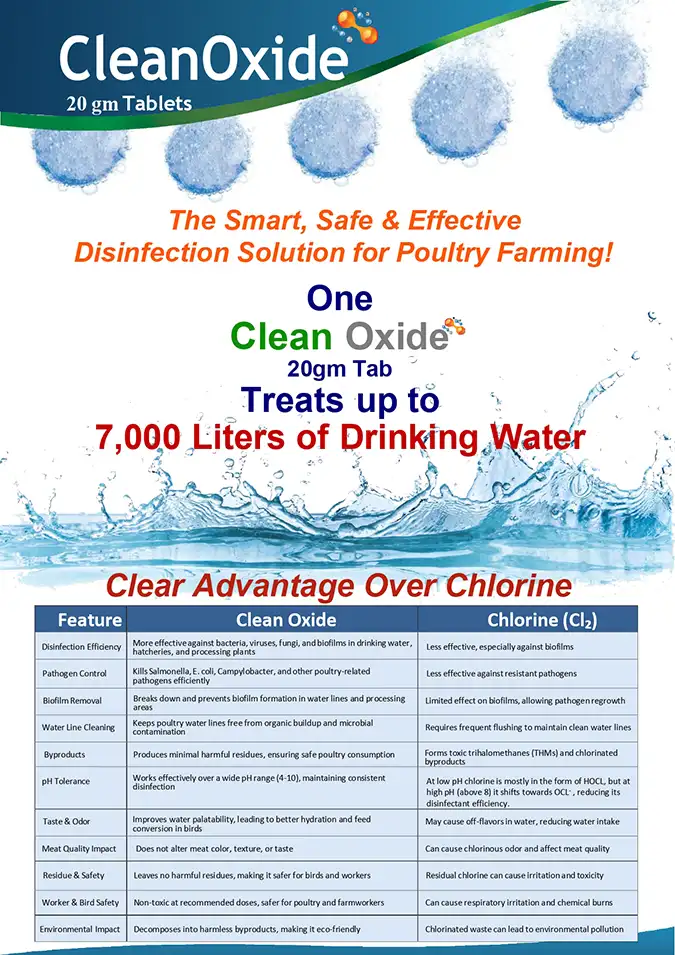
Clean Oxide Tablets are chlorine dioxide-releasing disinfectant tablets used for water sanitation and farm hygiene. Each 20 gm tablet treats up to 7,000 liters of drinking water, making it a highly economical option.
They work by releasing chlorine dioxide, a powerful oxidizing agent. As a result, they effectively kill harmful microorganisms without producing toxic residues. Consequently, this poultry water disinfection solution offers both safety and efficiency in poultry operations.
Key Benefits of Clean Oxide Tablets
Superior Disinfection Efficiency
Clean Oxide eliminates bacteria, viruses, fungi, and algae with up to 99.99% effectiveness. Therefore, this water disinfectant for poultry ensures comprehensive microbial control in water systems.
Powerful Biofilm Removal
Unlike traditional chlorine, Clean Oxide breaks down existing biofilms and prevents future formation. As a result, water lines remain clean for longer periods with the use of this Water disinfectant for poultry farming.
Safe and Non-Toxic
Clean Oxide produces minimal harmful byproducts. Furthermore, it leaves no toxic residues and remains safe for birds and workers when used correctly.
Wide pH Effectiveness
This poultry water disinfection solution works efficiently across a broad pH range (4–10). Therefore, it maintains consistent performance under varying water conditions.
Improves Water Quality
Clean Oxide removes sulfur compounds, precipitates iron and manganese and improves taste and odor. Consequently, birds consume more water, which improves feed conversion ratio (FCR).
Long-Lasting Action
This Water disinfectant for poultry farming provides a 48–72 hour residual antimicrobial effect. Thus, it ensures continuous protection against microbial contamination.
Eco-Friendly and Non-Corrosive
Clean Oxide decomposes into harmless substances. In addition, this water disinfectant for poultry farming remains safe for pipes, tanks, and equipment.
Impact on Poultry Performance
Clean Oxide directly improves farm productivity. For example:
- It increases water intake
- It improves feed efficiency
- Moreover, it reduces disease incidence
- It lowers mortality rates
- It enhances growth performance
Ultimately, these improvements lead to higher profitability for poultry farmers.
Clean Oxide vs Chlorine: A Clear Advantage
Traditionally, chlorine has been widely used for water disinfection. However, Clean Oxide offers significant improvements. It stands out as a next-generation alternative to chlorine-based disinfectants.
- Delivers superior biofilm control
- Produces no harmful residues
- Performs effectively across a wider pH range
- Enhances water taste and improves intake
- Ensures greater safety for birds and workers
Clean Oxide delivers broad-spectrum antimicrobial action, while chlorine shows limited effectiveness, especially against biofilms. Moreover, Clean Oxide effectively eliminates resistant pathogens, whereas chlorine often fails under field conditions.
In addition, Clean Oxide prevents biofilm formation and keeps water lines clean. On the other hand, chlorine requires frequent flushing and maintenance. Furthermore, Clean Oxide produces minimal byproducts, while chlorine forms harmful compounds like trihalomethanes (THMs).
Clean Oxide also works efficiently across varying pH levels. In contrast, chlorine loses effectiveness at higher pH levels. Similarly, Clean Oxide improves water taste, whereas chlorine reduces water intake due to unpleasant odor.
Most importantly, Clean Oxide ensures safety. It leaves no harmful residues, protects workers, and does not affect meat quality. Meanwhile, chlorine may cause irritation, toxicity, and environmental pollution.
How to Use Clean Oxide Tablets
Clean Oxide offers versatile applications across poultry farms. Therefore, farmers can use this water disinfectant for poultry farming for both water treatment and disinfection.
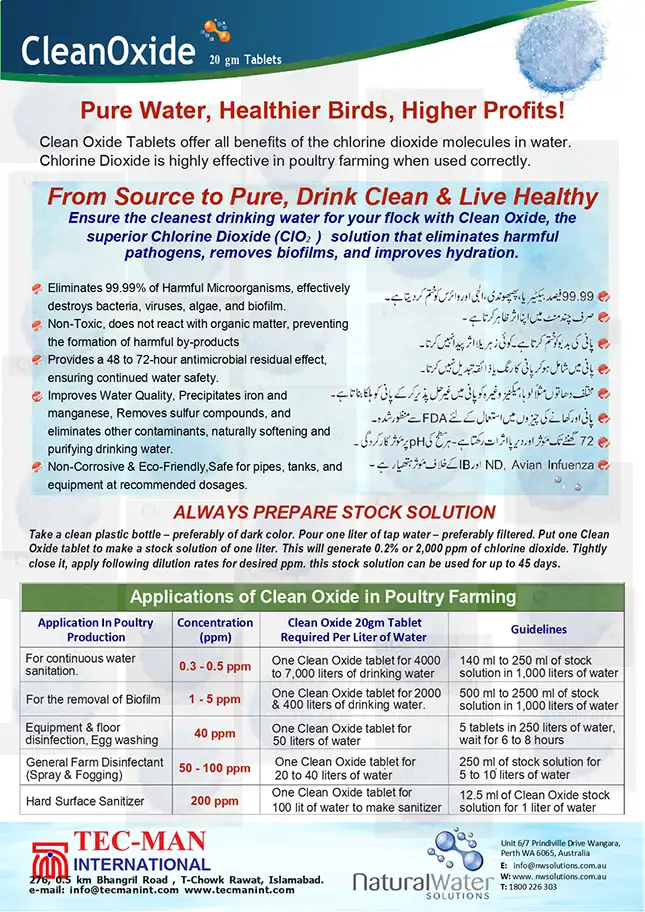
Always prepare stock solution to use it. Take a clean plastic bottle – preferably of dark color. Pour one liter of tap water – preferably filtered. Put one Clean Oxide tablet to make a stock solution of one liter. This will generate 0.2% or 2,000 ppm of chlorine dioxide. Tightly close it, apply following dilution rates for desired ppm. This stock solution can be used for up to 45 days.
Dose Rates
Here is the details of dose rates for different applications.
Continuous Drinking Water Sanitation
Dose: 0.3 – 0.5 ppm
Clean Oxide ensures safe daily water supply. As a result birds drink more water, feed intake is improved and FCR becomes better
Biofilm Removal from Water Lines
Dose: 1 – 5 ppm
It removes stubborn biofilms and organic buildup. Consequently, it prevents recurring infections and maintains pipeline hygiene.
Equipment & Floor Disinfection (Including Egg Washing)
Dose: 40 ppm
This application reduces environmental contamination. Moreover, it improves hatchery hygiene and prevents cross-infection.
General Farm Disinfection (Spray & Fogging)
Dose: 50 – 100 ppm
It controls airborne pathogens and enhances farm biosecurity. Therefore, it is ideal during disease outbreaks and routine sanitation.
Hard Surface Sanitization
Dose: 200 ppm
It provides deep cleaning of high-risk surfaces. As a result, it ensures maximum hygiene in critical areas.
Table for Application and Dose Rates
| Application in Poultry Production | Concentration (ppm) | Tablet Requirement | Guidelines |
| Continuous water sanitation | 0.3 – 0.5 ppm | One tablet for 4,000–7,000 liters of drinking water | Use 140–250 ml stock solution per 1,000 liters of water |
| Removal of biofilm | 1 – 5 ppm | One tablet for 400–2,000 liters of drinking water | Use 500–2,500 ml stock solution per 1,000 liters of water |
| Equipment & floor disinfection, egg washing | 40 ppm | One tablet for 50 liters of water | Use 5 tablets in 250 liters of water and wait 6–8 hours |
| General farm disinfectant (spray & fogging) | 50 – 100 ppm | One tablet for 20–40 liters of water | Use 250 ml stock solution for 5–10 liters of water |
| Hard surface sanitizer | 200 ppm | One tablet for 100 liters of water | Use 12.5 ml stock solution per 1 liter of water |
Practical Farm Integration Strategy
For best results, farmers should adopt a combined approach with this poultry water disinfection solution. First, use low-dose daily sanitation for drinking water. Then, apply periodic biofilm removal treatments. Additionally, perform routine equipment disinfection and fogging.
This integrated strategy ensures complete farm hygiene and disease control.